hyperuniform-samplers
Hyperuniform Point Clouds Database



This is the GitHub companion repository of the Hyperuniform samples database stored on Zenodo. The database contains hyperuniform point clouds (e.g. blue noise) on the unit hypercube [0,1)ᴰ.
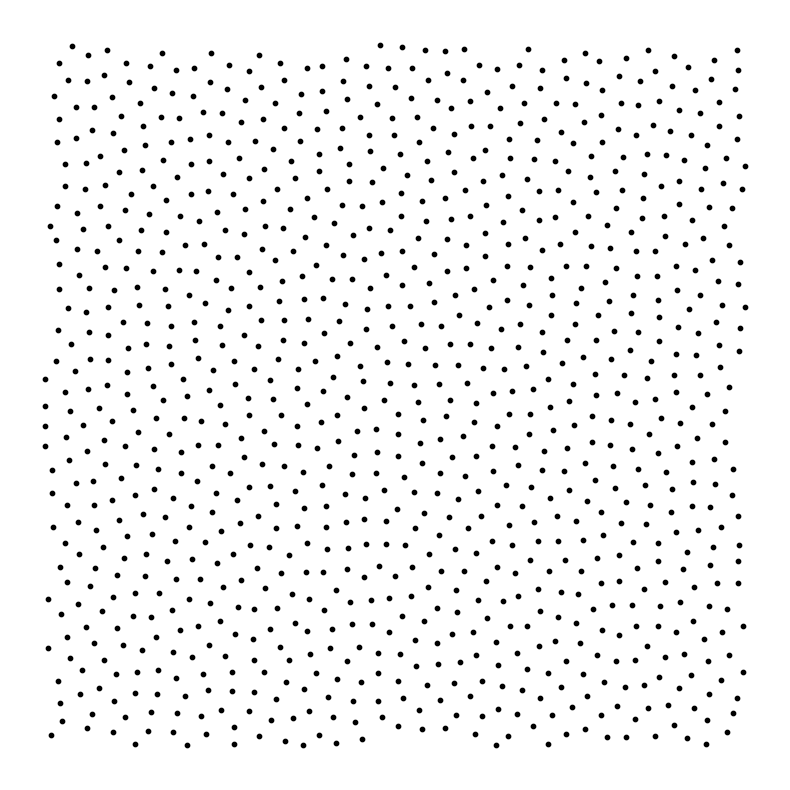
2D example (the N = 1024, D = 2 point clouds (l2) of this database) :
Installation
pip install numpy h5py
Quick Start
First clone this repository:
git clone https://github.com/For-a-few-DPPs-more/hyperuniform-samplers.git
cd hyperuniform-samplers
Then, from the terminal, load the full database and generate a new randomized point cloud:
python src/load_data.py --dim all --ball all
python src/new_data.py --dim 2 --npoints 1024 --ball l2 --seed 42
Or from a notebook: see quick_start.ipynb and follow the instructions.
Data characteristics
- Format: HDF5 (Python, C++, MATLAB, Julia, R, …).
- Size: ≈ 500 MB by default, ≈ 3.2 GB with the large point clouds (see note below).
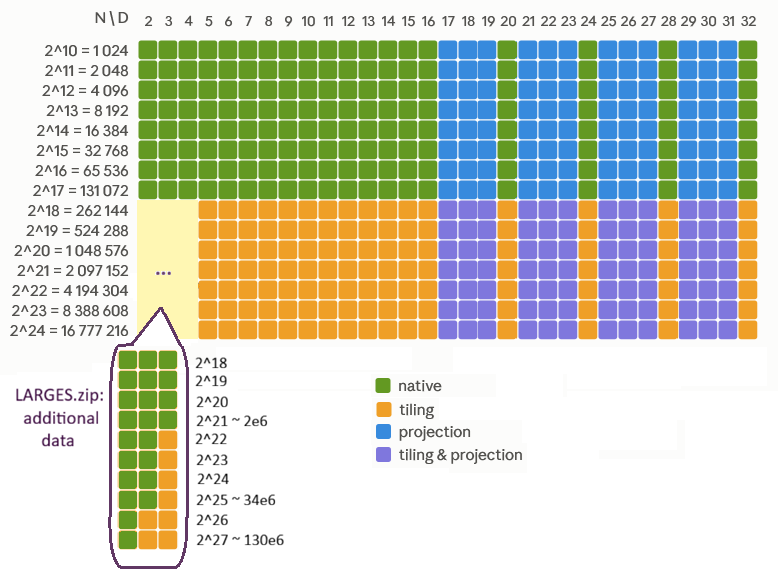
- Number of points: native N = 2¹⁰ to 2¹⁷ (powers of 2); up to N = 2²⁴ with tiling.
- Dimension: native D = 2 to 16, plus D = 20, 24, 28 and D = 32; any 2 ≤ D ≤ 32 with projection.
Note: Large storage. In low dimensions (D ≤ 4), the Zenodo database provides additional, much larger point clouds, to be downloaded manually (
larges.zip, 2.7 GB). They go up to N = 2²⁷ ≈ 134 million points in 2D, 2²⁵ ≈ 34 million in 3D and 2²¹ ≈ 2 million in 4D.
Sampling method
The samples were generated by spectral optimisation (non-uniform Fourier transform) with the qmc-sampler python package: the sampling algorithm select a spectral exclusion set, initialise the point cloud with random i.i.d points on the unit hypercube, then run a gradient descent on the Fourier loss, then complete the optimisation with a quasi-newton finishing to reach an exact minimum (up to the float32 precision). Each resulting point cloud comes in two versions:
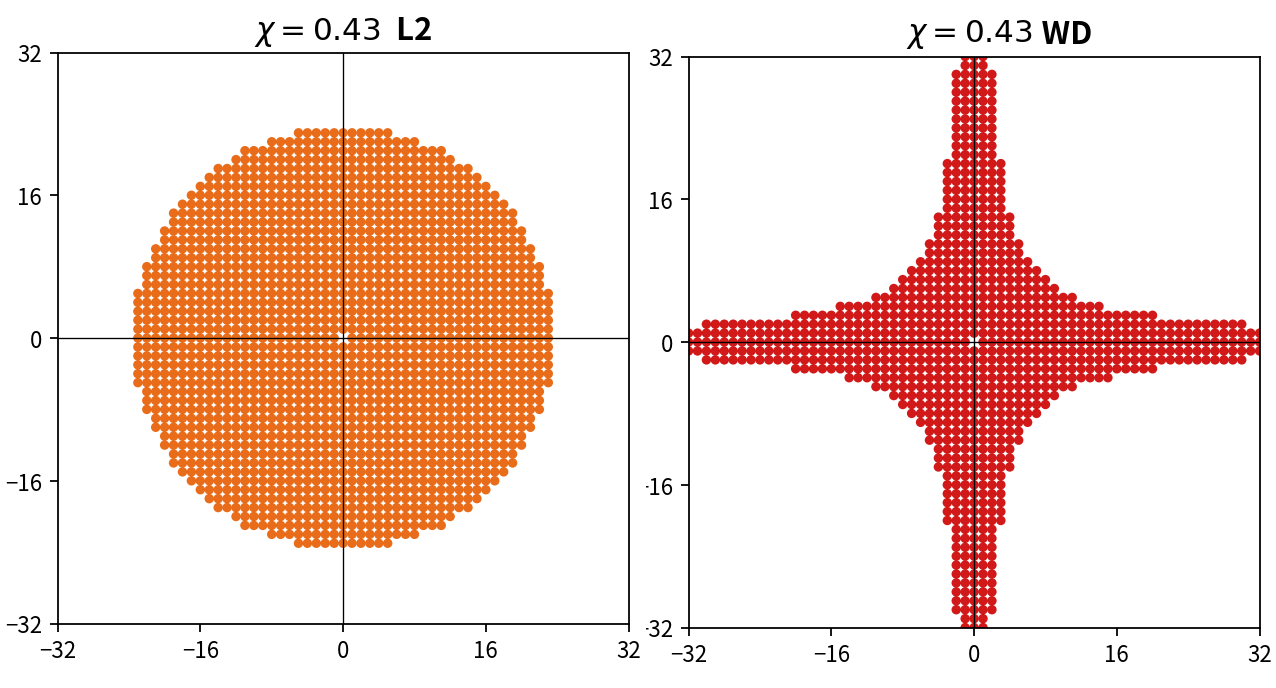
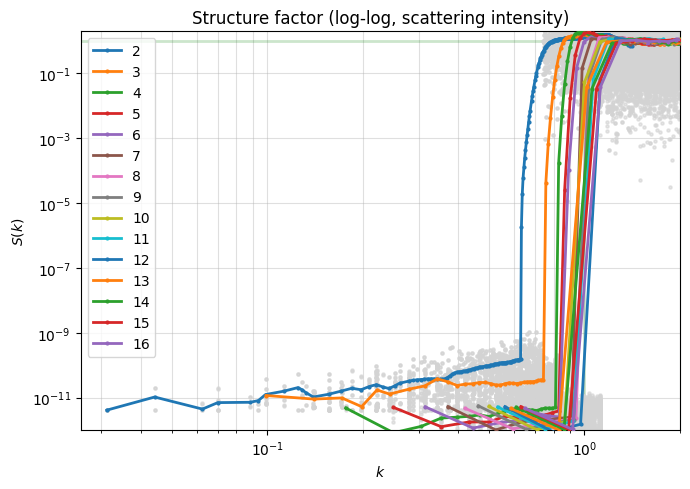
- l2: stealthy scattering intensity S(k) ≤ 10⁻¹⁰ in a standard Euclidean ball (thus, an “l2” ball) of wave vectors;
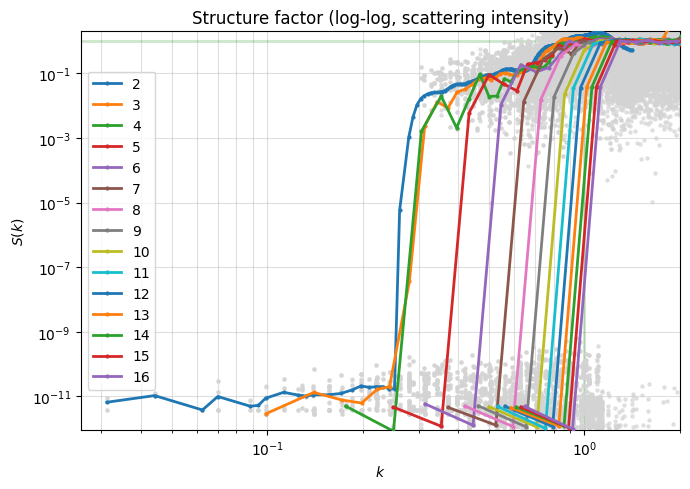
- wd: stealthy scattering intensity S(k) ≤ 10⁻¹⁰ in an exclusion set defined as r(k) >= cst, where r(k) is the fourier decomposition of the wrap-around discrepancy (thus, “wd” which stand for wrap-around discrepancy);
Note that l2 is isotropic (rotation invariant), which is good for blue noise propertys, and wd has a stary, axis oriented shape which is good for qmc integration on low effective dimensional integrands:
All details for reproducibility are in SAMPLING.md.
Guarantees
Stealthiness
For a wave vector k = (k₁, …, k_D) with integer components,
S(k) = |Σⱼ exp(2iπ ⟨k, xⱼ⟩)|² / N
A near-zero S(k), as here for the provided samples (S(k) ≤ 10⁻¹⁰ on the exclusion set) means that the Monte Carlo integration error is controlled for the low-frequency test function x ↦ exp(2iπ ⟨k, x⟩). The number of such controlled wave vectors is 2 * Chi * (N -1) * D where Chi is an hyperparametter that we set to 0.43 (common choices are 0.3 and 0.4, see for exemple Morse et al. (2023) ) and the factor 2 comes from the symmetry S(k) = S(-k).
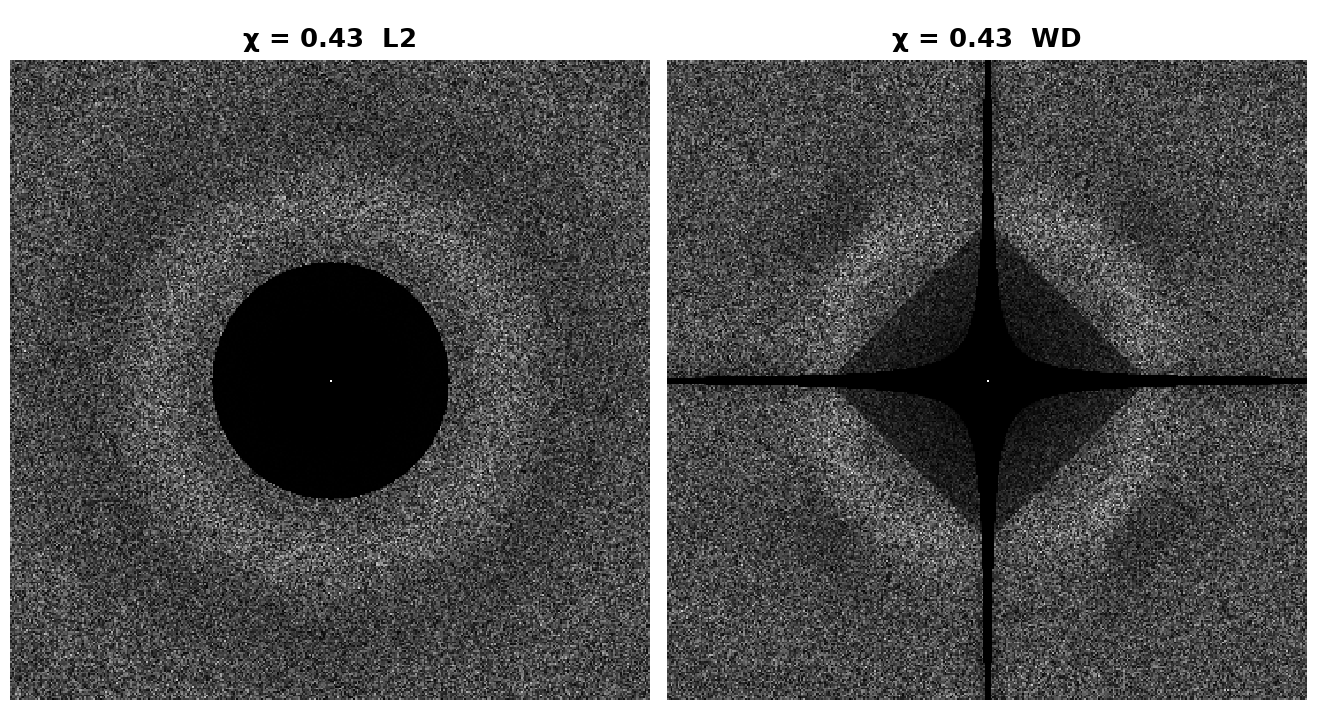
Following plots show the values of S(k) for the 2 ball families, 1. as a power spectrum map (kx, ky) ↦ S(k) for 2d point clouds only and 2. as a radial k ↦ S(k) curve (average over radial bins) for all dimensions D = 2 to 16 :
- (kx, ky) ↦ S(k) power spectrums
N = 8192, D = 2
- k ↦ S(k) curves
l2 ball, N = 1024, D = 2 to 16
wd ball, N = 1024, D = 2 to 16
Randomisability
Spectral optimisation enforces periodic boundary conditions, so a sample can be randomised by a simple shift:
X_new = (X - s) mod 1, s drawn uniformly in [0,1]^D
Extensibility
src/load_data.py downloads the samples with 2¹⁰ ≤ N ≤ 2¹⁷ and D = 2 to 16, 20, 24, 28, 32. Other (N, D) shapes are produced on the fly by src/new_data.py, at a controlled loss of quality:
-
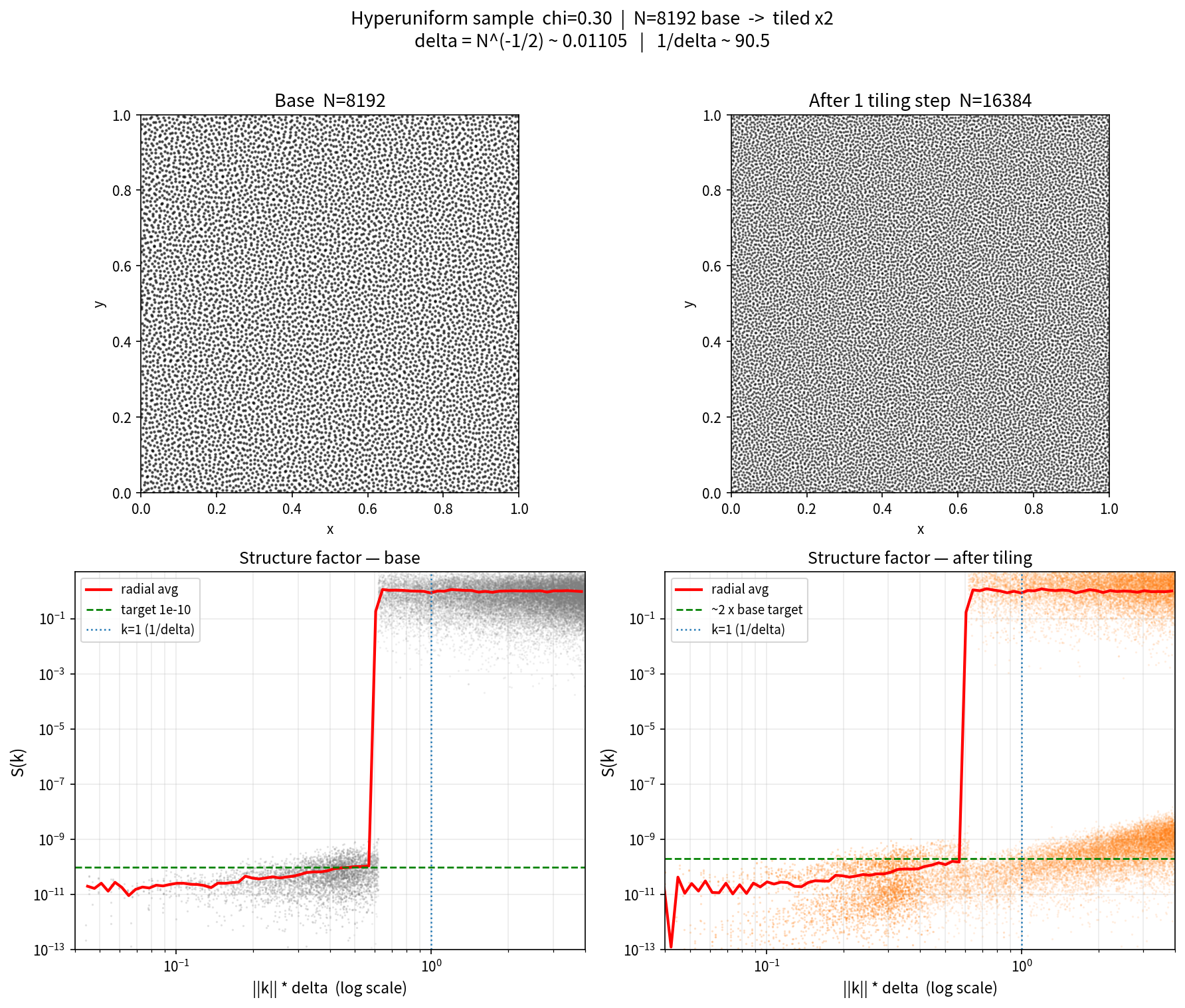
Tiling (more points): copies of the periodic point cloud are combined into a larger one, up to N = 2²⁴. The stealthiness degrades proportionally to the increase in points:
sup S_t(k) = sup S(k) × N_t / Nwhere N is the original number of points and N_t the number after tiling. See TILING.md.
-
Projection (lower dimension): 17 ≤ D_proj ≤ 19 is projected from D = 20, 21 ≤ D_proj ≤ 23 from D = 24 and so on. See PROJECTION.md.
Use cases
- Rendering and blue noise: anti-aliasing, path tracing, dithering, denoising textures.
- Spatial sampling: isotropic particle initialisation (SPH, molecular dynamics) with periodic boundary conditions.
- Monte Carlo / QMC integration: especially for periodic or smooth integrands, see BENCHMARK.md for discrepancy comparison with Sobol and Halton sequences. Random shifts give independent replicas for error bars
- Machine learning and design of experiments: initial designs, uncertainty quantification.
- Hyperuniformity research: reference data to study structure factors and to benchmark new samplers.
Note - adaptative sampling Although this database contains only uniform samples, spectral methods proposed in SAMPLING.md support adaptative sampling, by passing a target distribution to the sampler. This could be of use for importance sampling or when one require well distributed points, but under a specific spatial distribution.
Acknowledgements
GPU kernel reductions rely on PyKeOps:
Charlier, Feydy, Glaunès, Collin, Durif, “Kernel Operations on the GPU, with Autodiff, without Memory Overflows”, JMLR 22(74), 2021.
The large 2D and 3D point clouds rely on FINUFFT:
Barnett, Magland, af Klinteberg, “A parallel non-uniform fast Fourier transform library based on an exponential of semicircle kernel”, SIAM J. Sci. Comput. 41(5), 2019.
Citation
If you use this database, you can cite it as:
@dataset{bardenet_lachiezerey_decacqueray_2026_hyperuniform,
  author    = {Bardenet, Rémi and Lachièze-Rey, Raphaël and de Cacqueray, Armand},
  title     = {Hyperuniform samples (stealthy point clouds)},
  year      = {2026},
  publisher = {Zenodo},
  version   = {v5},
  doi       = {10.5281/zenodo.23244509},
  url       = {https://doi.org/10.5281/zenodo.23244509}
}
Licence
The database and the source code are free to use under the MIT licence.