hyperuniform-samplers
Exclusion Sets and incomplete orbits:
The sampling process to build the hyperuniform database proceeded as follows:
- Initialize with random i.i.d. points.
- Select a spectral exclusion set $
\Omega$ based on a chosen geometry (L2ball orWDball), with a budget of $M = \lfloor \chi \cdot D \cdot (N-1) \rfloor$ wave vectors (note that we count the pair $(k, -k)$ as a single wave vector due to spectral symmetry), where $\chi = 0.43$, to compute the Fourier loss:
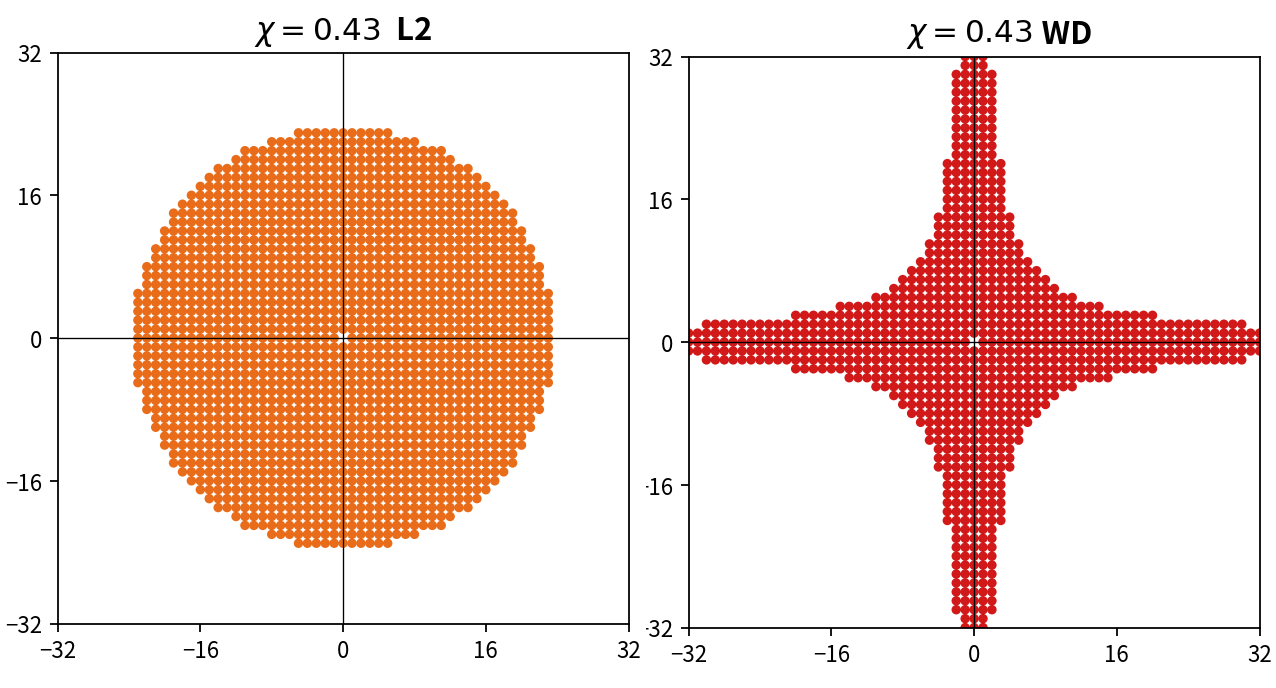
- This is what a typical exclusion set looks like for 2D wave vectors (the geometrical constructions also generalise to $
D > 2$) and ballsL2andWD:
- The set $
\Omega$ is built by accumulating complete orbits ($weight(k) = cst$, where weight is the squared L2 norm of the wave vector $k$ forL2, or the wrap-around discrepancy coefficient forWD) until the budget $M$ is reached. The last orbit, which would be incomplete, is truncated (discarded), so that $\Omega$ only contains complete orbits.
The spectral bound $S(k) \le \varepsilon$ is only guaranteed on complete orbits, which is why the incomplete one is discarded. As a consequence, the number of wave vectors actually used is $M_{\text{eff}} \le M$, which results in an effective
This is especially critical in high dimensions, where a single orbit can contain thousands of wave vectors: discarding the last one can leave $\chi_{\text{eff}}$ at only a small fraction of the nominal $\chi$.
1. Orbit Definitions
| Ball | Exclusion Region | Weight $w(k)$ |
Orbit Definition (Modes of Equal Weight) |
|---|---|---|---|
L2 |
$L_2$ ball |
$\Vert k\Vert_2^2$ |
Shells where $\Vert k\Vert_2^2 = \text{const}$ |
WD |
Star ball | $r(k) = \prod_i \hat{K}(k_i)$ (Fourier coefficient of the wrap-around discrepancy) |
Shells where $r(k) = \text{const}$ |
2. Worst-Case $\chi_{\text{eff}} / \chi$ by Dimension
Analysis for $N = 2^{10}$ to $2^{17}$, with $D = 2$ to $16$, and $D = 20, 24, 28, 32$.
For the remaining dimensions ($17 \le D \le 19$, $21 \le D \le 23$, $25 \le D \le 27$, and $29 \le D \le 31$), the incomplete-orbit effect combines with an additional projection effect. The exact $\chi_{\text{eff}} / \chi$ table, including both effects, is provided in PROJECTIONS.md.
The following table reports the worst-case $\chi_{\text{eff}} / \chi$, in percent (higher is better). The worst case is the minimum across $N = 2^{10}, \ldots, 2^{17}$.
Dimension ($D$) |
L2 |
WD |
|---|---|---|
| 2–3 | 98% | 94% |
| 4–6 | 79% | 96% |
| 7–9 | 67% | 87–96% |
| 10–12 | 35% | 76% |
| 13–16 | 18% | 63% |
| 20 | 14.08% | 49.10% |
| 24 | 10.26% | 57.38% |
| 28 | 6.37% | 65.26% |
| 32 | 7.27% | 38.17% |
3. Black, Gray and Light Gray Lists
These are the point clouds with the lowest $\chi_{\text{eff}} / \chi$, and thus the least effective use of the spectral exclusion budget. All of them are L2 point clouds: WD never falls below 38% in the dimensions considered.
Black: 5–10% (3 point clouds)
| Ball | D | N |
|---|---|---|
L2 |
24 | $2^{13}$ (10.26%) |
L2 |
28 | $2^{10}$ (6.37%) |
L2 |
32 | $2^{10}$ (7.27%) |
Gray: 10–20% (9 point clouds)
| Ball | D | N |
|---|---|---|
L2 |
16 | $2^{11}$ (17.7%) |
L2 |
20 | $2^{12}$ (14.08%) |
L2 |
20 | $2^{15}$ (15.52%) |
L2 |
24 | $2^{12}$ (20.52%) |
L2 |
24 | $2^{15}$ (13.85%) |
L2 |
24 | $2^{16}$ (13.85%) |
L2 |
28 | $2^{12}$ (14.08%) |
L2 |
28 | $2^{17}$ (11.26%) |
L2 |
32 | $2^{13}$ (18.51%), $2^{17}$ (17.11%) |
Light Gray: 20–30% (7 point clouds)
| Ball | D | N |
|---|---|---|
L2 |
13 | $2^{10}$ (23.0%) |
L2 |
14 | $2^{10}$ (26.8%) |
L2 |
15 | $2^{13}$ (24.6%), $2^{15}$ (29.1%) |
L2 |
20 | $2^{11}$ (28.18%) |
L2 |
20 | $2^{17}$ (25.95%) |
L2 |
24 | $2^{14}$ (27.71%) |
L2 |
28 | $2^{14}$ (28.17%) |
Conclusion
- Low-dimensional regime ($
D \le 3$): $\chi_{\text{eff}} \approx \chi$ for both balls, with negligible loss. - High-dimensional regime ($
D \ge 20$): Orbits become very wide, causing $\chi_{\text{eff}} / \chi$ to drop to as low as 6.37% for theL2ball at $D = 28$. - Robustness of the
WDball: Thanks to a much larger number of distinct orbits, truncating its last shell has a smaller impact. For the supplied dimensions $D = 20, 24, 28, 32$, the worst-caseWDratios are 49.10%, 57.38%, 65.26%, and 38.17%, respectively.